
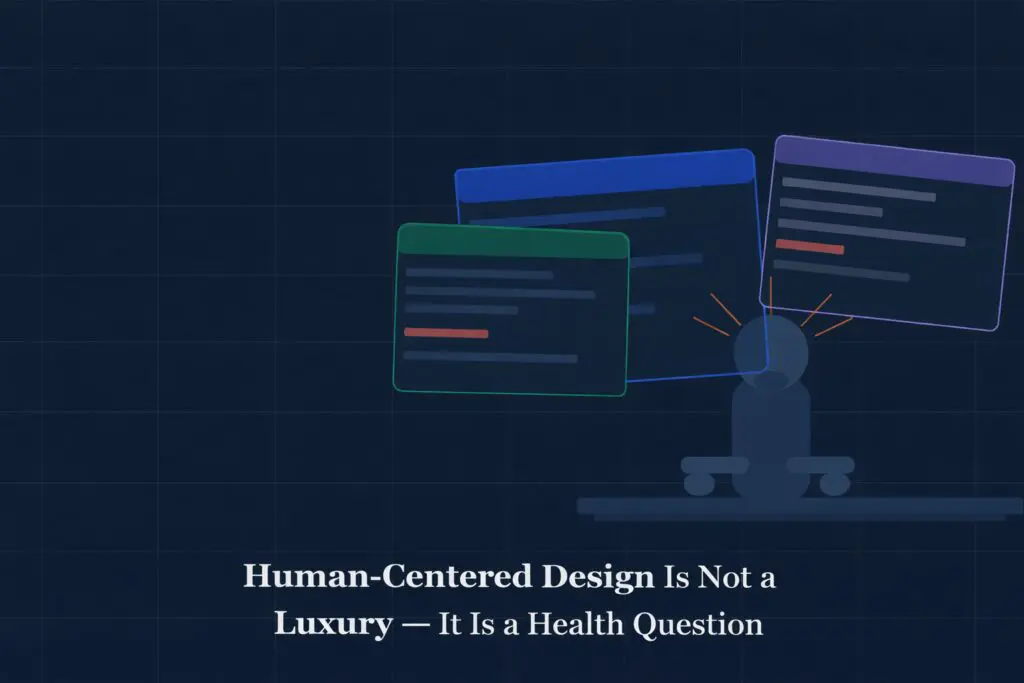
Mental Health Month isn’t just about wellness programs.
It’s about asking a harder question:
Are the tools we give people making their work easier—or slowly draining them?
Every May, organizations follow a familiar playbook:
- Wellness webinars
- EAP reminders
- A gratitude wall
These efforts have value. But they miss something deeper.
Are the systems your people use every day actually designed to support them?
The Invisible Cost of Bad Software
Cognitive load is the mental effort required to complete tasks.
Every time someone:
- Searches for a button that should be obvious
- Re-enters data the system should remember
- Deciphers an unclear error message
They spend mental energy.
Individually, these moments seem small.
Over time, they add up to something much bigger:
Exhaustion. Frustration. Burnout.
Research has shown this consistently:
Poorly designed software doesn’t just slow people down—it wears them out.
Every unnecessary click, every confusing workflow, every hidden piece of information has a cost.
And yet, we rarely talk about this when discussing workplace mental health.
What This Looks Like in Courts
Think about a court clerk.
In a single morning, they might:
- Open 10–12 cases
- Enter data
- Upload documents
- Update statuses
- Schedule hearings
Now imagine doing all of this in a system that:
- Doesn’t remember state
- Requires exact search formats
- Breaks workflows with small errors
That’s not just inefficient.
It’s mentally draining.
Now multiply that across:
- Full days
- Full weeks
- Emotionally complex cases
The work is already demanding.
The system shouldn’t make it harder.
This Isn’t Just a Court Problem
You’ll find the same pattern anywhere:
- Legacy systems patched over time
- Feature-heavy, user-unfriendly tools
- Software built without observing real users
The signals are there:
- Frustration
- Workarounds
- Exit feedback
But the root cause is often missed.
Human-Centered Design Is a Well-being Issue
Human-centered design starts with a simple idea:
The user is not an afterthought.
It means:
- Showing the right information at the right time
- Reducing unnecessary steps
- Using clear, predictable interfaces
- Respecting mental effort as limited and valuable
When we reduce cognitive load, we don’t just improve productivity.
We give people more capacity for meaningful work.
This isn’t theoretical.
In high-stakes environments like:
- Healthcare
- Legal systems
- Air traffic control
Better design leads to:
- Fewer errors
- Faster workflows
- Improved well-being
Poor design does the opposite.
What Actually Changes
When systems are redesigned around real workflows:
- Tasks become faster
- Errors decrease
- Frustration drops
But more importantly, the quality of the workday improves.
A hearing officer finding a case in two clicks instead of twelve isn’t just more efficient.
They are less fatigued, more focused, and better prepared.
That matters—for them and for the people they serve.
What Good Design Looks Like
Reducing cognitive load means:
- Fewer screens, more clarity
- Clear next actions
- Automation of repetitive tasks
- Helpful, recoverable error states
This isn’t complex technology.
It’s thoughtful design.
This Mental Health Month, Look Deeper
Wellness programs are not enough.
A yoga app won’t fix:
- Eight hours of poor software
- Months of daily friction
- Years of accumulated frustration
The real question is:
Were your systems designed with your people in mind?
- Did anyone observe real users?
- Was friction accepted—or challenged?
- Are your tools helping—or hurting?
Final Thought
Human-centered design is not a luxury.
It’s the baseline.
When we get it wrong, the cost doesn’t show up in reports.
It shows up in people—engaged at the start of the year, exhausted by the end.
About Azul Arc
Azul Arc is a digital product design and development firm with over 20 years of experience building human-centered platforms for courts, government agencies, and enterprise clients.
CaseHub, our purpose-built case management platform, is designed to reduce cognitive load for judges, clerks, and administrative staff—so they can focus on what truly matters.
Explore CaseHub: azularc.com/casehub
Connect: linkedin.com/company/azul-arc