
Introduction: The AI Pilot to Production Gap
AI pilot-to-production is where most enterprise AI efforts break down. Companies invest heavily in AI pilots, yet very few scale them into real-world impact.
The problem is not ambition. It is execution.
Organizations often celebrate early success in controlled environments. However, moving AI from pilot to production requires a different mindset, stronger ownership, and better systems.
A clear pattern is emerging. Some organizations scale AI successfully. Most do not.
AI Pilot to Production Gap Is Bigger Than It Looks
The numbers are hard to ignore.
Nearly 85–95% of AI projects fail to reach production. Many stall after the pilot phase. Others never deliver measurable business value.
Leaders approve AI initiatives with high expectations. Teams build promising prototypes. But when it is time to scale, progress slows down or stops completely.
This gap between experimentation and execution is now the biggest challenge in enterprise AI.
Why AI Pilot to Production Fails
Several common issues prevent organizations from scaling AI effectively.
1. Lack of Clear Ownership
Many AI projects do not have a single accountable owner. Teams work in silos, and decisions take longer. Without ownership, pilots rarely move forward.
2. Poor Data Readiness
AI depends on clean, structured, and accessible data. Most organizations underestimate this requirement. As a result, models fail when exposed to real-world complexity.
3. Over-Reliance on Generic Tools
Many teams depend on off-the-shelf AI solutions. These tools work in demos but struggle in production environments. They lack flexibility and domain alignment.
4. No Integration with Core Systems
AI pilots often run in isolation. They are not connected to existing workflows or systems. This limits their real-world usefulness.
5. Success Metrics Are Unclear
Teams define success differently. Some focus on model accuracy. Others look at business outcomes. This misalignment creates confusion and delays decisions.
Why Generic AI Fails in Production
Generic AI solutions promise speed and simplicity. However, they often fail under real operational pressure.
They cannot adapt to unique workflows. They struggle with complex data environments. Most importantly, they do not align with business goals.
As a result, organizations remain stuck in the AI pilot to production phase.
Why Purpose-Built AI Solutions Work
Successful organizations take a different approach.
They invest in custom, purpose-built AI systems. These systems are designed around real workflows, not assumptions.
They also focus on:
- Strong data pipelines
- Clear ownership
- Seamless integration
- Measurable outcomes
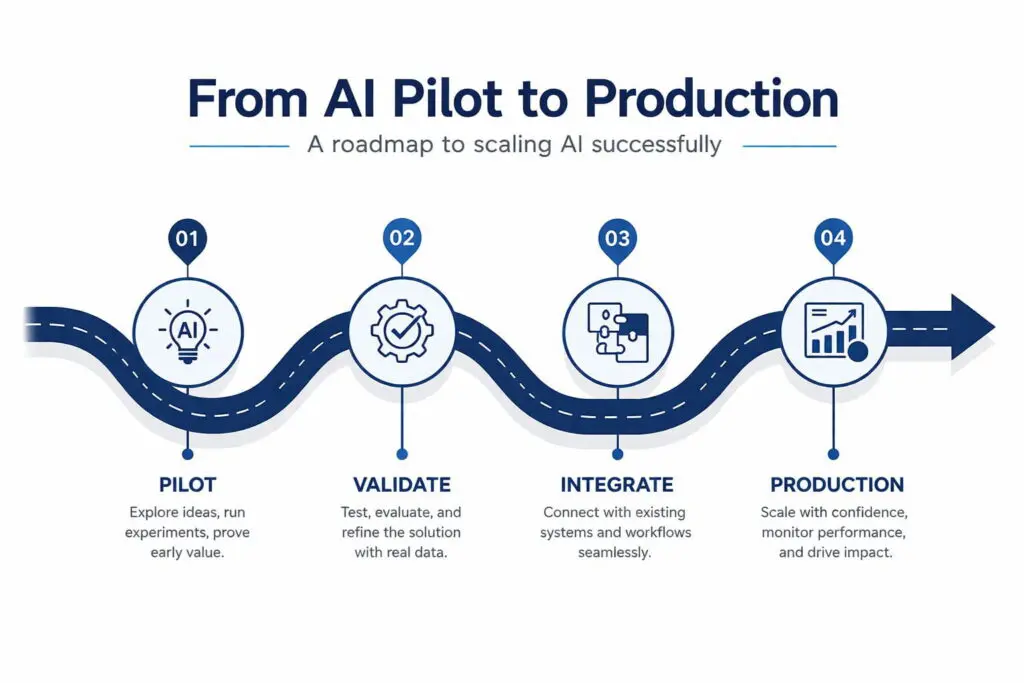
This approach helps them move from AI pilot to production faster and more effectively.
How to Move AI from Pilot to Production
Organizations that succeed follow a clear set of practices.
1. Start with Business Outcomes
Define success early. Focus on measurable impact, not just technical performance.
2. Build for Integration
Ensure AI systems connect with existing tools and workflows. Integration drives adoption.
3. Prioritize Data Quality
Invest in clean and structured data. This is the foundation of scalable AI.
4. Assign Clear Ownership
Give one team or leader full responsibility. This speeds up decision-making.
5. Scale in Phases
Do not jump directly to full deployment. Expand gradually and learn at each stage.
The Role of Platforms Like CaseHub
Modern platforms like CaseHub help bridge the AI pilot to production gap.
They provide:
- Centralized workflows
- Better data visibility
- Scalable architecture
- Faster deployment cycles
Such platforms enable organizations to move beyond experimentation and deliver real outcomes.
Conclusion: Closing the AI Pilot to Production Gap
The AI pilot to production gap is not a technology issue. It is a strategy and execution problem.
Organizations that succeed focus on clarity, ownership, and integration. They align AI initiatives with real business needs.
Those who fail remain stuck in endless pilots.
The difference is simple.
Not capability. Not budget.
It is the ability to execute.