
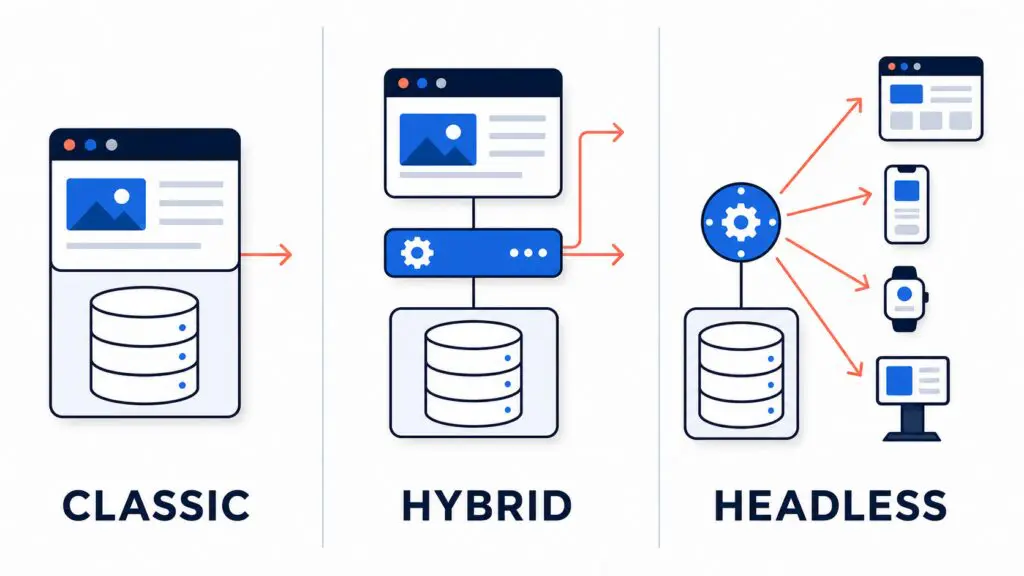
Every few years the content management conversation resets, and 2026 is one of those years. Headless has lost its novelty and picked up a track record, both good and bad. Classic platforms quietly got faster and more composable. And a large middle ground has emerged where a single platform can render its own pages and serve content to anything else that asks.
So the question is no longer “which CMS is the most modern?” It is a much less glamorous question: where does your content actually need to go, and who has to keep it running once the launch party is over? After fifteen-plus years of designing and building websites, portals, and custom applications, that is the question we open every CMS conversation with. Here is the framework.
The three architectures, in plain language
Classic (monolithic). Content, templates, and rendering live in one system. You write a page, the platform renders the page, the visitor sees the page. Think WordPress or Drupal in their standard configuration. One codebase, one admin, one deploy.
Headless. The CMS becomes a content repository with an API on top, and nothing else. It has no opinion about how content looks. A separate front end (Next.js, Astro, Nuxt, a native app, a kiosk) fetches content over REST or GraphQL and renders it. Two systems, two deploys, two skill sets.
Hybrid. The platform can do both. It ships a rendering layer for the marketing site your team edits daily, and exposes the same content over an API for everything else. WordPress with the REST API or WPGraphQL is the most common example, and it is a genuinely good one.
When classic still wins
Unfashionable but true: for a large share of business websites, a well-built classic CMS is still the correct answer.
If your content has exactly one destination (your website), your editors are marketers rather than engineers, and your competitive advantage is publishing quickly rather than rendering exotically, a monolith gives you things headless makes you rebuild from scratch: true visual editing, reliable preview, page-level SEO controls, forms, redirects, sitemaps, a plugin for the thing you forgot, and a hiring pool of thousands. Speed is no longer a real objection either. A disciplined classic build with proper caching, an image CDN, and a lean theme hits strong Core Web Vitals without a separate front-end application.
The honest risk with classic is discipline. Monoliths degrade when nobody owns them: thirty plugins, a page builder generating four thousand DOM nodes, a theme forked past the point of upgrade. That is a governance failure, not an architecture failure, and re-platforming to headless does not cure it. It just gives the mess a newer accent.
When headless is worth it
Headless earns its extra cost in a specific set of conditions, and it is worth being ruthless about them.
Go headless when content genuinely has many consumers: a website plus a mobile app plus in-store screens plus a partner API plus a product configurator. Go headless when your front end is really an application, with logic, state, and interaction that a template language will fight you on. Go headless when content is a product, structured into reusable objects that several teams compose differently. And go headless when you have, or are willing to fund, a front-end team that owns a deploy pipeline.
What you get is clean separation, front-end freedom, edge rendering, and a content model that outlives any single design. What you also get is everything the monolith handled for free landing back on your backlog: preview environments, navigation management, redirects, search, forms, localization, sitemaps, analytics wiring, and a build step between a typo and its fix. None of it is hard. All of it is hours.
Why hybrid is the default in 2026
The last two years have produced a quiet correction. Teams that went fully headless for a brochure site discovered their marketers had lost the ability to ship a landing page without a developer, and some of them came back. That correction is exactly what hybrid absorbs.
A hybrid setup lets you serve your main site from the platform your editors already love, while exposing the same content over an API to a React app, a native app, or whatever surface appears next. You can also go headless incrementally: keep the blog and resource library classic, rebuild only the high-traffic or highly interactive routes as a decoupled front end. The content model is future-proofed, the editing experience survives, and you are not betting a year of roadmap on a rewrite.
Five questions that settle the debate
How many surfaces consume this content today, and how many will in eighteen months? One surface means classic or hybrid. Three or more means headless is paying for itself.
Who edits, and how often? Daily edits by non-technical marketers push hard toward classic or hybrid. Quarterly edits by a product team make headless painless.
What is your capacity after launch? Headless adds a second codebase to patch, upgrade, and staff. If there is no clear owner, you are choosing future technical debt.
Is your front end a site or an app? Heavy interaction, real-time data, personalization, or authenticated experiences favor decoupled. Pages with sections do not.
What has to integrate? Commerce, CRM, PIM, DAM, search, and personalization each pull toward structured content and APIs. Map the integrations before you map the architecture.
If four of your five answers point one direction, stop researching and start building.
The costs nobody puts in the estimate
The build number is the easy part. The parts that get missed: editorial preview and workflow in a headless setup, the extra security surface and dependency upgrade treadmill of two codebases, image pipelines and media governance, localization, and the ongoing hosting and observability cost of a decoupled front end. Add the human cost too. A CMS your team is afraid to touch produces stale content, and stale content costs more than any license.
AI has also changed the scoring in 2026. Answer engines and AI crawlers reward clean, structured, well-marked-up content, which is an argument for a disciplined content model regardless of architecture. Structured content is the actual win of the headless era. You do not need to go fully headless to get it.
Our take
Start with the content model, not the platform. Model your content as structured, reusable objects, then choose the thinnest architecture that can deliver it everywhere it needs to go. For most organizations in 2026, that is a well-governed hybrid: a fast classic-rendered site with an API ready for whatever comes next. Full headless is the right call when you have multiple real consumers and a team to own the front end. Full classic is the right call when you have one surface and editors who ship daily.
The wrong call is choosing based on what sounded most current in a vendor demo.
Trying to make this decision right now? We plan, design, and build both: high-performance classic and hybrid WordPress sites, and decoupled front ends backed by custom APIs. We will map your content model, your surfaces, and your team’s real capacity, then recommend the architecture we would pick if it were our own site. Schedule an intro call.