
Pew Research tracked roughly 68,000 real searches from 900 U.S. adults. When an AI summary appeared at the top of the results page, people clicked through to a website 8% of the time. Without one, they clicked 15% of the time.
Nearly half the clicks, gone. And about one in four users ended their browsing session entirely after reading the summary — that traffic didn’t go to a competitor. It stopped existing.
If your organic numbers have slipped this year while your rankings held steady, that’s the mechanism. It isn’t a penalty, a content quality problem, or an algorithm update you can wait out. The result page started answering the question itself.
Answer engine optimization — AEO, sometimes called generative engine optimization or GEO — is the practice of structuring a site so AI systems can find, understand, and cite it. It doesn’t replace SEO. It sits on top of it, and it’s rapidly becoming the difference between a site that’s visible in 2026 and one that quietly isn’t.
Ranking and getting cited are now two different jobs
Here’s the finding that should reorganize how you think about search: according to BrightEdge data, the overlap between Google’s top-10 organic results and the sources cited in AI Overviews has fallen to somewhere between 17% and 38%. A year earlier it was around 75%.
Read that again. You can hold position three for your most important term and still be absent from the answer most people actually read.
The zero-click numbers make the stakes clear. Roughly 60% of Google searches now end without a click to any website. In Google’s AI Mode, that figure reaches 93%. Informational queries — the “how does X work” and “what is Y” content most organizations build their blogs around — take the heaviest hit. Navigational and transactional queries hold up better, because someone who wants to file, pay, or apply still needs to arrive somewhere.
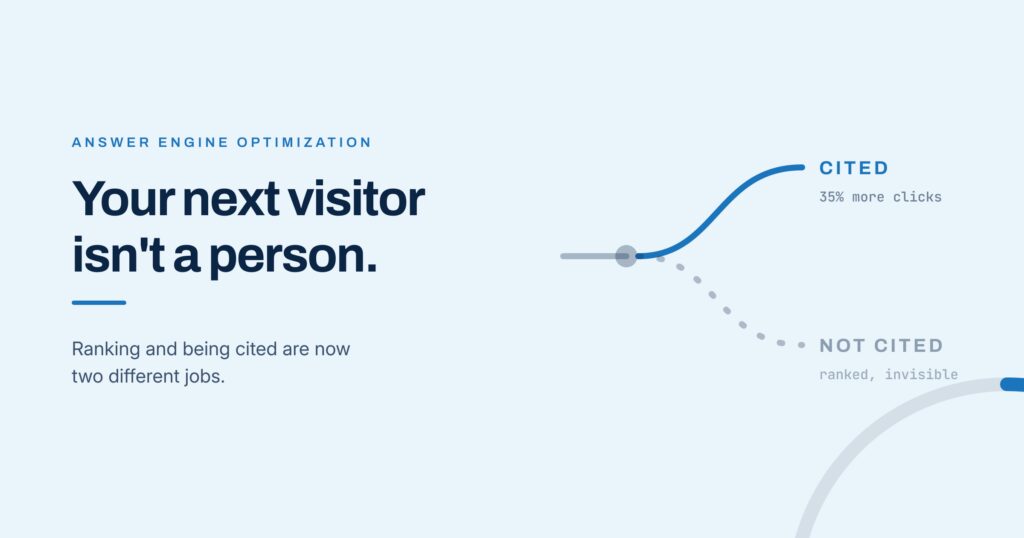
There’s an upside worth naming. Being cited pays. Seer Interactive found that brands appearing in AI Overviews earn about 35% more organic clicks than brands that don’t. The visitors who arrive have already read a summary, already know roughly what you do, and are looking for depth. Fewer clicks, better clicks.
So the goal shifts. Not “rank first.” Be the source the answer is built from.
The overlap nobody talks about: accessible markup is machine-readable markup
This is where most AEO advice goes vague, and where we think the practical answer actually lives.
AI systems parse pages the same way assistive technology does. They rely on the document’s structure — headings in a sensible order, semantic landmarks, descriptive link text, properly labeled tables and lists, alt text that describes the image, HTML that means something rather than a stack of unlabeled div elements.
A screen reader needs a clear “h2” to tell a user where a section begins. So does an extraction model deciding which chunk of your page answers a question. A screen reader can’t interpret an image of a chart with no alt text. Neither can a language model. Vague link text like “click here” fails a blind user navigating by links, and it fails a crawler trying to understand what you’re pointing at.
The practical upshot: the accessibility work many organizations have been treating as a compliance cost is the same work that determines whether AI systems can cite them. Semantic HTML, heading hierarchy, alt text, table markup — a WCAG-conformant site is, almost incidentally, a machine-readable one.
If you’ve already invested in accessibility, you’re further along on AEO than you think. If you haven’t, this is a second reason to, and it’s one with a revenue argument attached.
What actually works — and one thing that doesn’t
Skip llms.txt, for now. The proposed standard invites site owners to publish a plain-text file guiding AI crawlers. It sounds sensible. But an analysis of 137,000 sites found that 97% of llms.txt files receive zero visits — AI bots simply don’t look for them. Ahrefs research also indicates AI systems cite HTML pages and ignore Markdown versions. Don’t spend a sprint on it. Revisit if adoption changes.
Write self-contained answers. AI systems extract passages, not pages. A paragraph that only makes sense after reading the three above it won’t get quoted. Open each section with a direct, complete answer to the question in the heading, then elaborate. If someone lifted that paragraph out and pasted it somewhere else, would it still make sense on its own? That’s the test.
Be specific and attributable. Models favor content with concrete detail — figures, dates, named sources, real prices — over hedged generality. “Compliance deadlines vary” won’t be cited. “State and local entities serving 50,000 or more people face an April 26, 2027 deadline” will.
Name your entities. Write your organization’s name, your product names, and your locations explicitly rather than leaning on “we,” “our platform,” and “the region.” Models build associations between named entities. Pronouns break the chain.
Implement structured data. Organization, FAQ, Article, Product, and Breadcrumb schema give machines an unambiguous description of what a page contains. It’s one of the few technical changes with a direct line to citation eligibility.
Keep it consistent everywhere. Your name, address, description, and service list should match across your site, your Google Business Profile, and every directory that lists you. Contradictory information makes a model less confident about citing you at all.
Make sure you’re crawlable. One report found that 62% of enterprise brands are effectively invisible to generative AI models for technical reasons. Check whether your robots.txt blocks GPTBot, PerplexityBot, ClaudeBot, and Google-Extended. Blocking them is a legitimate strategic choice — but it should be a decision, not an accident from a template.
What this means if you run a CMS
Most of this is a content modeling problem, not a writing problem.
If your CMS makes editors format headings visually — bolding a line and bumping the font size instead of applying an actual “h2” — your structure is invisible to both screen readers and AI systems, no matter how well-organized the page looks. If schema markup requires a developer ticket every time, it won’t happen consistently. If your templates output generic markup, every page inherits the same handicap.
The fixes are unglamorous and durable: enforce heading levels in the editor, make alt text a required field, generate schema from templates automatically, and stop publishing critical content as untagged PDFs, which are opaque to assistive technology and to crawlers alike.
Measure it differently
Pageviews alone will now mislead you. A content program can be performing well and still show falling sessions.
Track alongside it: which pages get cited in AI answers, referral traffic from chat.openai.com, perplexity.ai, and claude.ai (set up a custom channel group in GA4 — it won’t appear on its own), branded search volume, and conversion rate by source. Rising branded searches while informational clicks fall is often a sign the strategy is working, not failing.
Where to start
Take your ten highest-value pages. For each one, ask three questions. Does every section open with a self-contained answer? Would a screen reader user be able to navigate it by headings alone? Does it name specifics — figures, dates, entities — or does it hedge?
Then fix the templates rather than the pages. Template-level changes scale across the whole site; page-level edits don’t.
The organizations that come out of this well won’t be the ones that chased the newest tactic. They’ll be the ones whose sites were built properly in the first place — clear structure, honest markup, specific content. That was good practice before AI search. It’s now the whole ballgame.
We’d love to be your technology partners. If your traffic is falling while your rankings hold, or you’re not sure whether your site is legible to AI systems at all, let’s talk.
Let’s turn your idea into a product.