
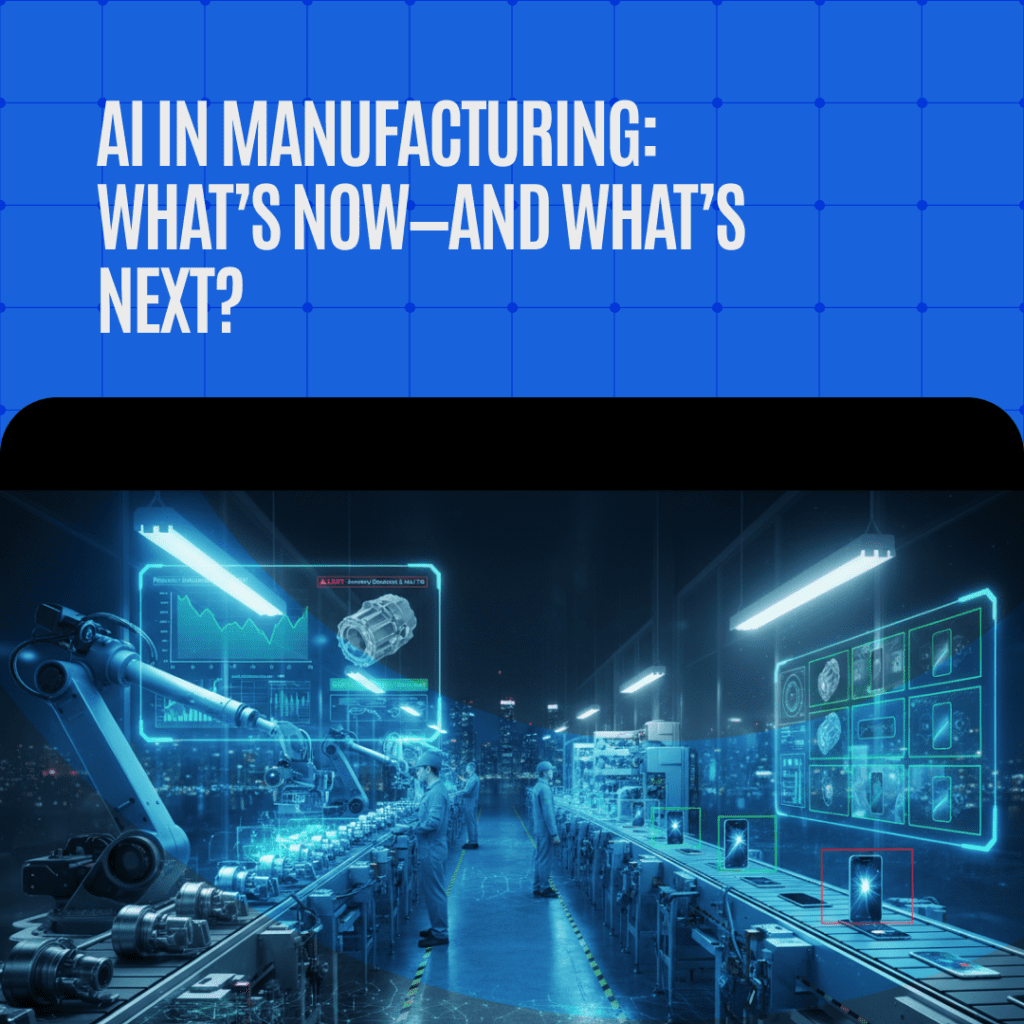
Artificial Intelligence (AI) is everywhere—from boardroom discussions to factory floors. But while industries are racing to adopt AI, manufacturing is moving at a more measured pace. Why? Because in this sector, success isn’t driven by hype—it’s driven by trust, control, and seamless integration.
The question isn’t whether AI will transform manufacturing—it already is. The real question is: how can manufacturers adopt AI in a way that actually works for their people, processes, and production realities?
Let’s break down what’s happening now—and what’s coming next.
What’s Happening Now: AI Is Already Delivering Value
Despite the perception that AI is still experimental, manufacturers are already using it in practical, high-impact ways.
1. Design Automation Is Accelerating Innovation
AI is transforming how products are designed. Today, engineers can generate CAD models using simple prompts, dramatically reducing design time and enabling faster iteration cycles.
This doesn’t replace engineers—it augments them, giving them a strong starting point rather than a blank canvas.
2. Simulation Is Becoming Instant
Traditionally, simulations in manufacturing could take days or even weeks. Now, AI-powered models—like neural surrogates—can deliver results in seconds with high accuracy.
This means:
- Faster product validation
- Reduced development costs
- Quicker time-to-market
3. Predictive Maintenance Is Reducing Downtime
AI is helping manufacturers shift from reactive to proactive operations. By analyzing real-time data, AI can predict equipment failures before they happen.
The result?
- Less unplanned downtime
- Longer equipment lifespan
- Improved operational efficiency
4. Quality Control Is Becoming Smarter
AI-powered vision systems can detect defects in real time—often more accurately than humans.
This leads to:
- Higher product quality
- Reduced waste
- Continuous improvement through learning systems
5. AI Is Taking Over Repetitive Tasks
From documentation to data entry, AI is eliminating time-consuming manual work, allowing engineers to focus on high-value problem-solving.
The Reality Check: Why Adoption Isn’t Faster
If AI is so powerful, why isn’t every manufacturer fully embracing it?
Because manufacturing isn’t just about innovation—it’s about precision, safety, and reliability.
1. Trust Is Non-Negotiable
Manufacturers deal with:
- Safety-critical systems
- Expensive machinery
- Strict compliance requirements
Even small errors can have major consequences. That’s why AI must be:
- Transparent
- Explainable
- Reliable
2. Control Over Data Matters
AI systems rely on data—but in manufacturing, that data is often:
- Proprietary
- Sensitive
- Business-critical
Companies are cautious about how AI models use and store their data, especially when it comes to intellectual property.
3. Integration Is the Biggest Barrier
Most manufacturers don’t operate in greenfield environments. They rely on:
- Legacy systems
- Multiple software tools
- Complex workflows
AI adoption isn’t just about adding a tool—it’s about fitting into an existing ecosystem without disruption.
What’s Next: The Future of AI in Manufacturing
AI is evolving quickly, and the next phase is about moving from experimentation to scale.
1. From Pilots to Production
Many organizations have tested AI—but few have scaled it. That’s changing.
AI will increasingly move into:
- Daily operations
- Core production workflows
- End-to-end systems
2. Hyper-Customization at Scale
One of the most exciting possibilities is on-demand manufacturing.
In the near future, AI could enable:
- Products designed from simple user inputs
- Mass customization without cost increases
- Highly personalized manufacturing processes
3. Connected AI Ecosystems
Instead of isolated tools, we’ll see:
- Integrated AI platforms
- Unified workflows across design, simulation, and production
- Seamless data flow across systems
This is where true digital transformation happens.
4. Human Roles Will Evolve—Not Disappear
AI won’t replace engineers—but it will change how they work.
Instead of creating everything from scratch, engineers will:
- Review AI-generated designs
- Focus on optimization and innovation
- Ensure quality and compliance
Where Most Companies Go Wrong
Many AI initiatives fail not because the technology doesn’t work—but because the approach is wrong.
Common mistakes include:
- Trying to “implement AI” all at once
- Ignoring existing workflows
- Overlooking user adoption
- Prioritizing technology over outcomes
AI isn’t a one-size-fits-all solution—it’s a strategic capability.
The Azul Arc Perspective: Making AI Work in the Real World
At Azul Arc, we see AI not as a standalone solution—but as a layer that enhances how systems already operate.
For manufacturing companies, this means:
1. AI That Fits Your Workflow
Instead of forcing teams to adapt to new tools, AI should:
- Integrate with existing systems
- Support current processes
- Enhance—not disrupt—operations
2. Reducing Errors, Not Just Automating Tasks
AI should focus on:
- Minimizing human error
- Improving decision-making
- Increasing consistency across operations
3. Building Trust Through Transparency
AI solutions must be:
- Explainable
- Reliable
- Aligned with compliance needs
Trust is the foundation of adoption.
4. Designing for People, Not Just Systems
Technology adoption fails when users resist it.
That’s why:
- UX matters
- Simplicity matters
- Training and usability matter
AI should feel like an assistant—not a replacement.
AI in manufacturing is no longer a future concept—it’s a present reality. But its success depends on how it’s implemented.
The companies that will win are not the ones that adopt AI the fastest—but the ones that adopt it the smartest.
They will:
- Focus on real business outcomes
- Prioritize integration over disruption
- Build trust across teams
- Scale thoughtfully
Final Thought
AI has the power to redefine manufacturing—but only if it’s grounded in reality.
The future isn’t about fully autonomous factories overnight.
It’s about intelligent, integrated, and human-centered systems that evolve over time.
And that’s where the real opportunity lies.