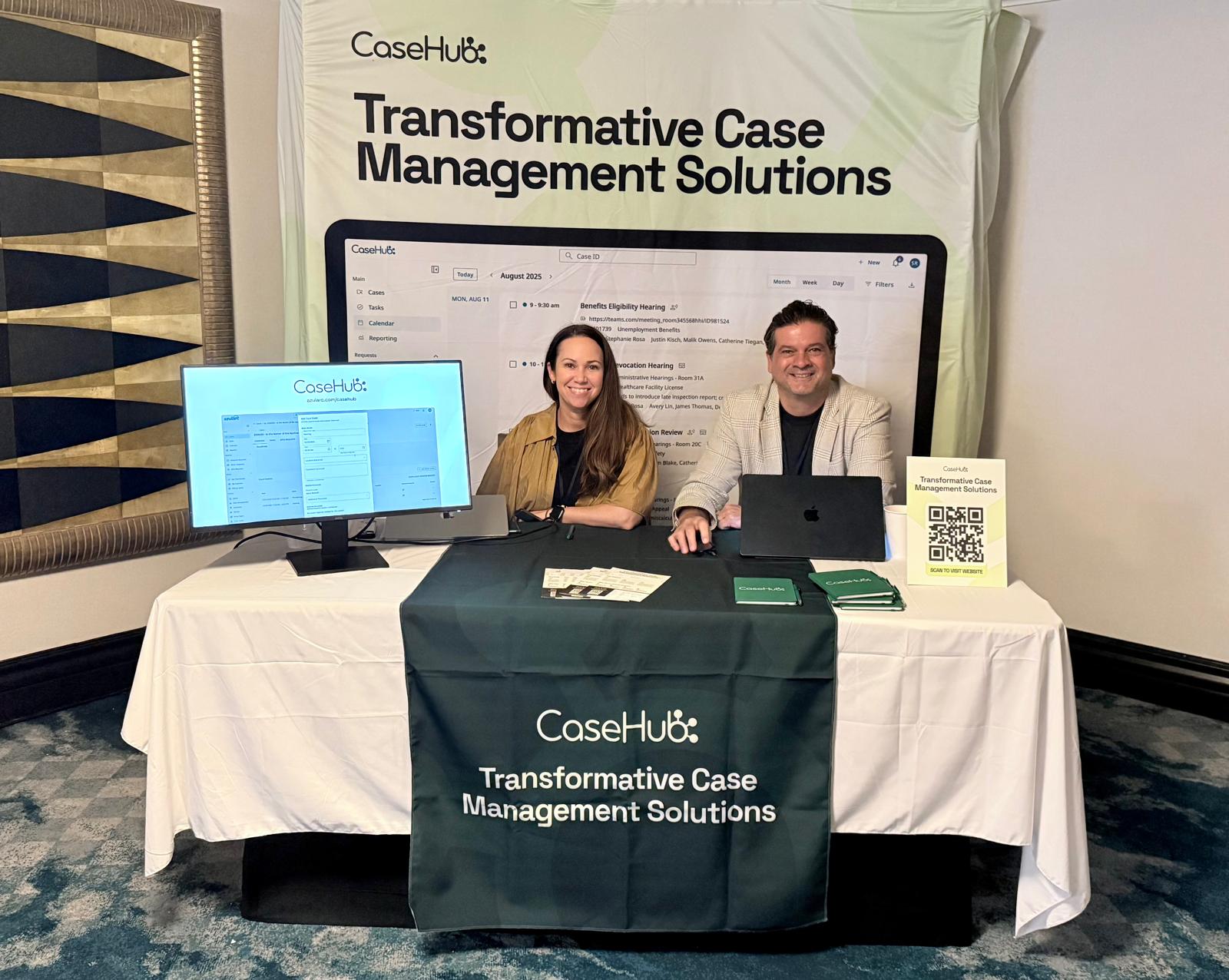
From October 4 to 7, Azul Arc traveled to the Crescent City as a Gold Sponsor of the National Association of Administrative Law Judiciary (NAALJ) 2026 Annual Conference, held at the Hilton New Orleans/St. Charles. Zahir Palanpur, CEO, and Jayme Clemons, VP of Operations, spent four days with administrative law judges, hearing officers, agency leaders, and legal practitioners from across the country.
Since 1974, NAALJ has worked to promote an impartial, professional administrative judiciary that holds itself to high ethical standards. Its annual conference is one of the few places where the people who run administrative hearings meet in one room to talk honestly about what’s working, what isn’t, and what’s coming. For a company that builds technology for this community, there’s no better place to listen.
Here’s our recap of the week, the themes that kept coming up, and what they mean for agencies planning their next step.
The Crescent City Conference on Administrative Justice
This year’s conference was called the Crescent City Conference on Administrative Justice, with the theme “Modern Justice with a New Orleans Spirit.” The theme fit. New Orleans is a city that respects its traditions and keeps reinventing itself, and administrative justice is trying to do the same thing.
The agenda was broad. Sessions covered professionalism and judicial ethics, employment law, military administrative law, mediation, maritime law, and mineral law and carbon capture. Speakers came from the Louisiana Supreme Court, the federal bench, the U.S. Military Academy, and the law schools at LSU, Tulane, and Loyola. Attendees also heard the latest security and survey findings that affect the administrative judiciary.
The program went beyond the classroom too. Attendees could join the historic Red Mass at St. Louis Cathedral, a long-standing tradition that marks the start of the judicial year, and spend an evening at the National WWII Museum. Those moments gave everyone room for the kind of informal, unhurried conversation that rarely fits into a packed session schedule.
AI Was the Thread Running Through Everything
If one topic shaped NAALJ 2026, it was artificial intelligence. It showed up throughout the agenda:
- AI discovery and capabilities, looking at what today’s tools can and can’t do.
- AI-related issues in the courts, presented by Judge Scott Schlegel of the Louisiana Fifth Circuit Court of Appeal, who is nationally recognized for his work on judicial innovation and bringing emerging technology into courtroom practice.
- AI and legal ethics, covering confidentiality, competence, and the duty of candor in an AI-assisted world.
- AI and administrative law, on how agencies and tribunals should approach automation in decision-making.
The conversation has clearly matured. A few years ago, AI at a legal conference usually meant either hype or fear. In New Orleans, the discussion was practical and grounded. Judges weren’t asking whether technology will change their work. They were asking how to adopt it responsibly while protecting what makes administrative justice legitimate: impartiality, due process, transparency, and public trust.
We agree with that framing. The tools should serve the people doing the work, not the other way around. AI can help staff triage filings, flag missing documents, summarize long records, and surface scheduling conflicts. But the judgment, the hearing and the decision belong to people. The best technology makes room for that judgment instead of trying to replace it.
What We Heard Between Sessions
Sessions set the agenda, but the most valuable insights at NAALJ came from the hallways, lunches, and evening events. We talked with judges, directors, and staff from many different states and agency types, and the same challenges kept coming up.
- Systems that slow people down. We heard plenty of frustration with case management platforms that need too many clicks, make searching hard, and push judges and clerks into workarounds. When a system is hard to use, people stop trusting it, and that shows up in data quality, turnaround times, and staff morale.
- Disconnected agency workflows. Many hearings offices still receive referrals from agencies by email, paper or manual re-entry. Several attendees told us they want cases to flow in directly from referring agencies, with documents and party information attached, so staff aren’t retyping what already exists somewhere else.
- The push for public access. Parties, attorneys and the public expect to file documents, check case status and get notices online, the same way they do with almost every other service. Many offices still don’t have a true public eFiling portal, and they feel that gap more every year.
- Rising caseloads, flat staffing. Almost everyone we spoke with is being asked to handle more cases without a matching increase in staff or budget. Efficiency isn’t a nice-to-have anymore. It decides whether an office can meet its statutory timelines.
- Long budget cycles. Government technology decisions often run on fiscal-year budgets that are submitted many months ahead. Offices that want to modernize need to start planning early, and they need partners who understand that procurement reality instead of ignoring it.
None of this is new to anyone who works in administrative adjudication. What stood out was how consistent it was. Whether we were talking to a large central panel or a small specialized tribunal, the core needs were the same: simpler tools, connected workflows, public access and more capacity.
Where CaseHub Fits
These are exactly the problems Azul Arc built CaseHub to solve.
CaseHub is a modern case management platform designed specifically for administrative hearings offices and the agencies they serve. Instead of adapting a generic court or legal practice system, we built CaseHub around how administrative adjudication actually works, from referral to final decision.
CaseHub brings together:
- Case intake and agency integration, so referrals arrive with the right data and documents already attached.
- Scheduling and calendaring for judges, parties, interpreters and hearing rooms, including in-person, phone and video hearings.
- eFiling and public portals that let parties and attorneys submit filings and track their cases online.
- Document generation and management, including notices, orders and decisions built from configurable templates.
- Reporting and analytics that give leadership a clear view of caseloads, timelines and bottlenecks.
CaseHub is already live with state hearings agencies [in multiple states / name approved states], and it’s designed to be extensible. Each office has its own statutes, case types and procedures, so CaseHub is configurable rather than one-size-fits-all. As new case types show up or rules change, the platform adapts without a full rebuild.
Our approach to AI follows the same thinking we heard in New Orleans. We focus on practical, transparent capabilities that remove administrative burden and leave judicial decision-making firmly in human hands.
Why Sponsoring NAALJ Matters to Us
For Azul Arc, sponsoring NAALJ is about much more than a booth and a logo. It’s a commitment to the community we serve.
Administrative law judges decide matters that directly affect people’s lives: benefits, licenses, employment, education, health care, and more. The systems behind those decisions should be as dependable, fair and accessible as the people using them. Supporting NAALJ is one way we invest in that mission and stay close to the people whose feedback shapes our product.
Every conversation we had in New Orleans goes back into our roadmap. When a judge tells us a search takes too long, or a director explains why agency referrals are a daily headache, that becomes something concrete we can improve.
Looking Ahead
NAALJ 2026 showed that administrative justice is at a turning point. The pressure to modernize is real, the technology is ready, and the profession is approaching it with care. Offices that plan now, especially with long budget cycles in mind, will be the ones best placed to serve the public well in the years ahead.
We left New Orleans energized, with a full notebook and a long list of new connections. Thank you to the NAALJ leadership, the conference organizers and the speakers for an outstanding program, and to every judge and practitioner who took time to talk with us.
Let’s Keep the Conversation Going
If we met at NAALJ, thank you, and we’d love to pick up where we left off. If we didn’t get a chance to connect, it’s not too late. Whether you’re just starting to think about modernization or you’re ready to replace a legacy system, our team is happy to talk through your goals and show you what CaseHub can do.
Schedule a CaseHub demo →